Yaseer Arafat
No More Guessing, No More Grinding: How AI is Revolutionizing DevOps ✨
The tech landscape is in constant motion. Driven by relentless market demand for faster, more reliable software, DevOps teams face immense pressure. It’s a continuous balancing act: developers push innovation at lightning speed 🚀, while operations ensure stability and scalability in increasingly complex environments 📈. This inherent tension often leads to bottlenecks ⛔, soul-crushing manual tasks 😩, and the ever-present threat of costly errors and outages 💥.
For years, DevOps principles—automation, collaboration, continuous improvement—have been our guiding stars. Tools like CI/CD pipelines, Infrastructure-as-Code (IaC), and robust monitoring have significantly streamlined software delivery. Yet, even with these advancements, modern systems remain complex. Distributed microservices, intricate dependencies, multi-cloud deployments, and a flood of operational data can easily overwhelm human capacity. This persistent challenge often traps teams in the “guesswork and grinding” cycle DevOps was designed to eliminate, leading to reactivity and burnout.
But what if there was a better way? 🤔
Enter Artificial Intelligence (AI). AI is no longer a futuristic concept; it’s a tangible, disruptive force actively reshaping industries. Its integration into DevOps is rapidly moving from theory to reality. By harnessing the power of Machine Learning (ML), Natural Language Processing (NLP), and advanced pattern recognition, we can inject unparalleled intelligence, adaptability, and foresight into every facet of the DevOps lifecycle.
This isn’t just about simple automation. It’s a profound paradigm shift towards smart, self-optimizing, and resilient systems. AI promises to:
- Dramatically alleviate manual toil. 🧘♀️
- Furnish deeper, actionable insights into system behavior. 🧠
- Proactively optimize performance, preventing issues before they arise. 🔮
- Empower developers and operations pros to focus on true innovation: designing, building, and deploying cutting-edge software that solves complex problems. 💡
This comprehensive article dives deep into the transformative potential of AI in DevOps. We’ll explore its measurable impact, dissect the technical underpinnings, and cast a compelling vision for a future where “no more guessing, no more grinding” becomes the new normal for software development and operations. 🚀
The Enduring Pains: Why “Guesswork and Grinding” Persists in DevOps 🚧
Before embracing the AI-powered future, let’s confront the persistent pains of traditional DevOps. These are the very inefficiencies, complexities, and human-intensive activities that AI is uniquely positioned to solve.
1. The Inescapable Burden of Manual Toil: Despite strong automation efforts, many DevOps tasks remain stubbornly manual and repetitive.
- Deployments: Still involve intricate scripting, meticulous environment configurations, and bespoke release orchestration, demanding constant human oversight. 📝
- Testing: Even with automation, crafting nuanced test cases, executing complex end-to-end scenarios, and laboriously triaging results often requires significant manual effort. 🐞
- Monitoring Alerts: The daily deluge leads to “alert fatigue,” where teams are desensitized by constant notifications—many false positives—missing critical alerts. 🔔 These manual processes are not just time-consuming; they are prone to human error, leading to costly downtime, performance degradation, and security vulnerabilities. This toil actively stifles innovation, diverting precious engineering hours from strategic initiatives.
2. The Labyrinthine Complexity of Modern Systems: Microservices, cloud-native architectures, and highly distributed systems have introduced mind-boggling complexity.
- Interactions: Understanding dynamic interactions between hundreds or thousands of microservices across multiple clouds is a monumental task. 🕸️
- Root Cause Analysis: Diagnosing elusive issues across disparate services and tracing root causes through convoluted event chains requires synthesizing vast, heterogeneous datasets in real-time. Human teams are inherently limited. 🕵️♂️
- Reactive Troubleshooting: This complexity often forces teams into reactive troubleshooting, relying on guesses, intuition, and laborious manual log inspection instead of data-driven, proactive optimization. 🌀
3. The Unrelenting Data Deluge & Alert Fatigue: Modern IT infrastructure and applications are prolific generators of data.
- Overwhelm: While monitoring tools collect data, its sheer volume is overwhelming. 🌊
- Desensitization: Operations teams succumb to “alert fatigue,” where critical alerts are lost in a flood of noise. 🔇
- Inefficiency: Manually sifting through unstructured data to find patterns and actionable insights is inefficient and mentally taxing. 😵💫
4. The Pernicious Silos of Insights: Even with advanced data collection, insights often remain isolated.
- Disconnected Data: Performance data might not easily correlate with recent code changes, infrastructure configurations, or user behavior. 🔗❌
- Lost Context: This lack of interconnectedness makes pinpointing root causes and holistic system optimization extraordinarily difficult, prolonging incident resolution.
5. The Inherently Reactive Nature of Operations: Many operations teams operate reactively, responding to incidents after they impact users.
- Post-Mortem: While incident response is vital, a proactive approach—anticipating and preventing issues before they manifest—is far more desirable and cost-effective. 🚒➡️🛡️
- Limited Foresight: Achieving this proactive posture requires predicting problems, recognizing anomalies, and dynamically optimizing systems based on trends—capabilities often beyond human analysis or static automation.
6. The Intrinsic Challenges of Scaling Expertise: As software systems grow, so does the required breadth and depth of technical expertise across programming, cloud, containers, databases, security, and more.
- Talent Scarcity: Finding and retaining engineers with such expansive, cross-domain knowledge is a perpetual challenge. 🧩
- Bottlenecks: This scarcity creates bottlenecks, hindering new technology adoption and limiting operational scalability. AI offers a pathway to democratize some of this expertise.
These challenges highlight an urgent need for a new DevOps paradigm – one that fundamentally leverages AI’s transformative power to inject unparalleled intelligence, sophisticated automation, and truly proactive capabilities across the entire software delivery lifecycle.
AI as the Catalyst: Injecting Intelligence into DevOps ⚡
AI, with its diverse array of sophisticated techniques, offers an unprecedented toolkit to comprehensively address the multifaceted limitations inherent in traditional DevOps practices. It paves the way for a profoundly more efficient, reliable, and developer-centric future, moving beyond the static limitations of rule-based systems to dynamic, learning, and adaptive environments. Here are the pivotal areas where AI is orchestrating a profound and measurable transformation:
1. Intelligent Automation: Beyond Scripts to Self-Learning Systems AI fundamentally elevates automation from predefined scripts to systems capable of learning, adapting, and making autonomous, intelligent decisions without explicit human instruction for every scenario. This is the realm of hyperautomation, where AI components augment and elevate traditional automation tools.
- Smart Code Suggestions & Completion (e.g., GitHub Copilot, TabNine):
These AI-powered pair programmers are revolutionizing the act of coding. By analyzing vast code repositories and current context, AI models (often LLMs) provide:
- Context-aware code suggestions. ✍️
- Complete lines or functions.
- Generate boilerplate code from natural language prompts. This accelerates development, reduces cognitive load, minimizes errors, and allows developers to focus on architectural decisions and innovation. Result: a substantial boost in developer productivity and code quality.
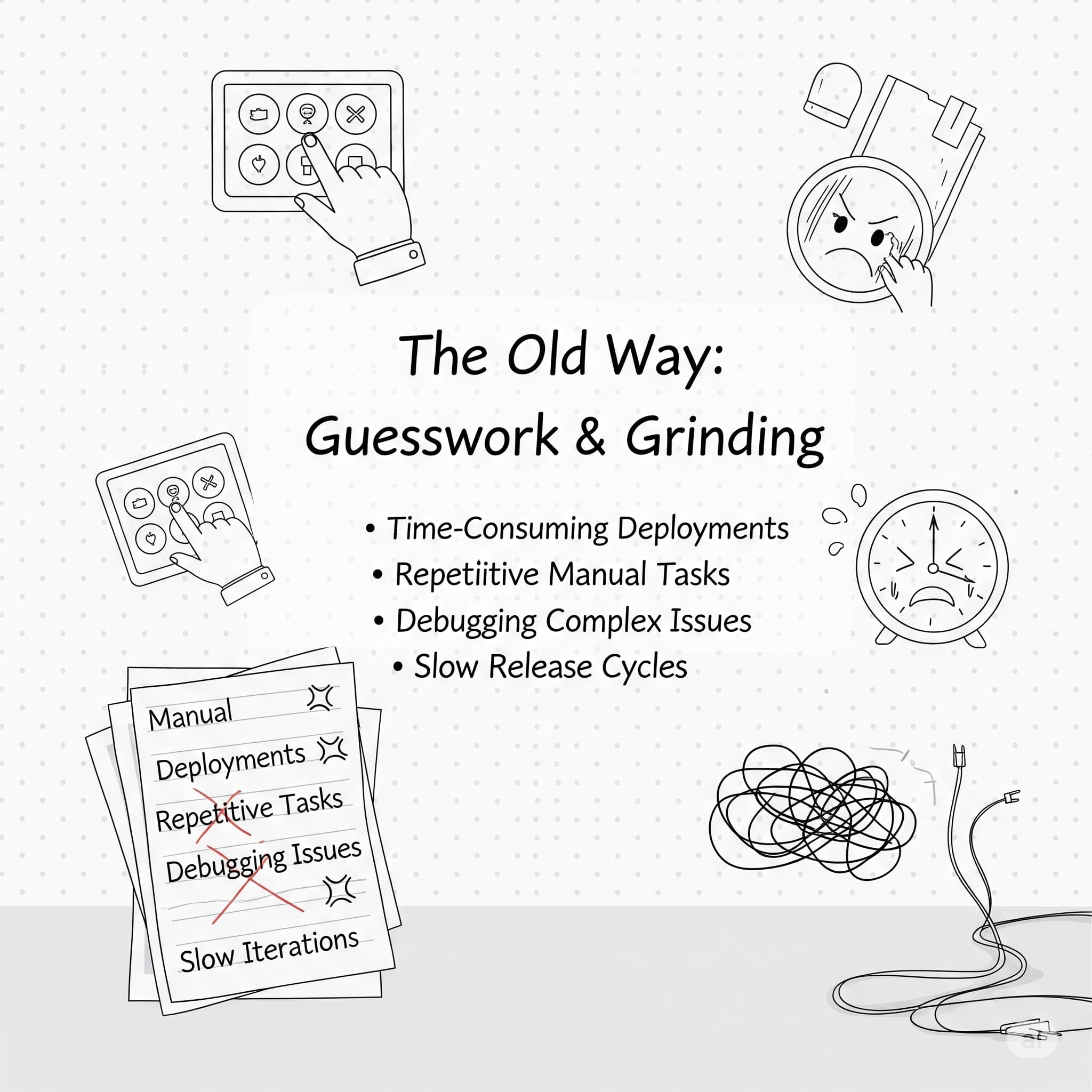 Caption: Depicting the frustrations of manual, error-prone traditional DevOps workflows.
- Automated Testing with AI (e.g., AI-powered UI test generation, intelligent test selection):
AI is transforming testing. Instead of manual test case crafting:
- AI automatically generates effective test cases based on code changes, user behavior, and historical failures, even for complex UIs. 🧪
- Intelligent test selection prioritizes and runs only the most impactful tests based on recent changes and blast radius. This drastically reduces testing time while improving coverage and effectiveness. AI can also analyze test results to identify patterns, predict failures, and suggest fixes, moving beyond simple pass/fail. Reinforcement learning can even train agents to explore application states and find bugs.
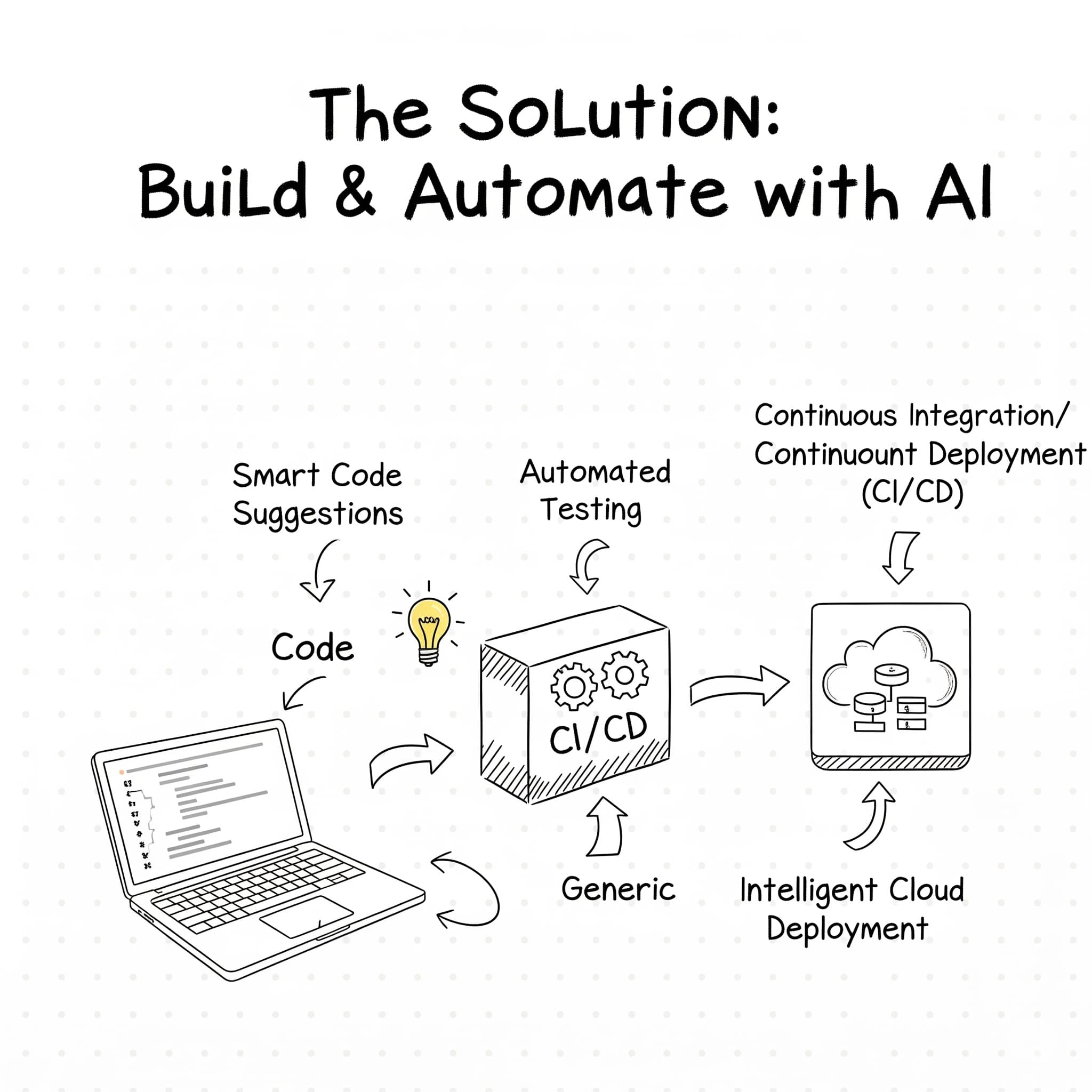 Caption: Depicting AI-powered solutions for DevOps.
-
Intelligent Deployment Orchestration (e.g., AIOps-driven release management): AI can optimize deployment strategies by analyzing a multitude of factors: historical deployment success rates, infrastructure performance metrics, real-time traffic patterns, and even external risk factors. AI-powered deployment tools can autonomously determine optimal deployment windows, intelligently orchestrate complex multi-stage rollouts, and even perform automated rollbacks on detected anomalies. This significantly reduces deployment risks, minimizes human errors, and dramatically shortens Mean Time To Recovery (MTTR), thereby boosting system reliability. 🚀
-
Automated Remediation & Self-Healing Systems: This is the pinnacle of intelligent automation. AI-powered monitoring not only detects anomalies but also automatically triggers sophisticated remediation actions based on learned patterns, historical incident data, and predefined policies.
- Examples: Autonomously restarting a failing microservice, isolating a problematic node, or scaling resources for load spikes, to even executing complex diagnostic playbooks. 🩹 Such capabilities dramatically improve system resilience, reduce manual intervention in routine (or even novel) issues, and free up operations teams from constant firefighting for strategic improvements.
2. Predictive Analytics & Proactive Operations: Anticipating the Future AI’s unparalleled ability to process and analyze vast, disparate data for hidden correlations and temporal patterns enables a fundamental shift from reactive incident response to a highly proactive operational posture. This is the core of AIOps.
- Predictive Failure Detection (e.g., anomaly detection in time-series data):
By continuously analyzing historical logs, performance metrics, infrastructure telemetry, and change management records, AI algorithms (e.g., RNNs, statistical anomaly detection) learn “normal” system behavior. They identify subtle, nascent indicators of impending failures long before user impact. This foresight allows operations teams to:
- Preemptively replace failing hardware. 🚦
- Reconfigure overloaded services.
- Patch vulnerabilities. Result: Averted downtime and enhanced system stability.
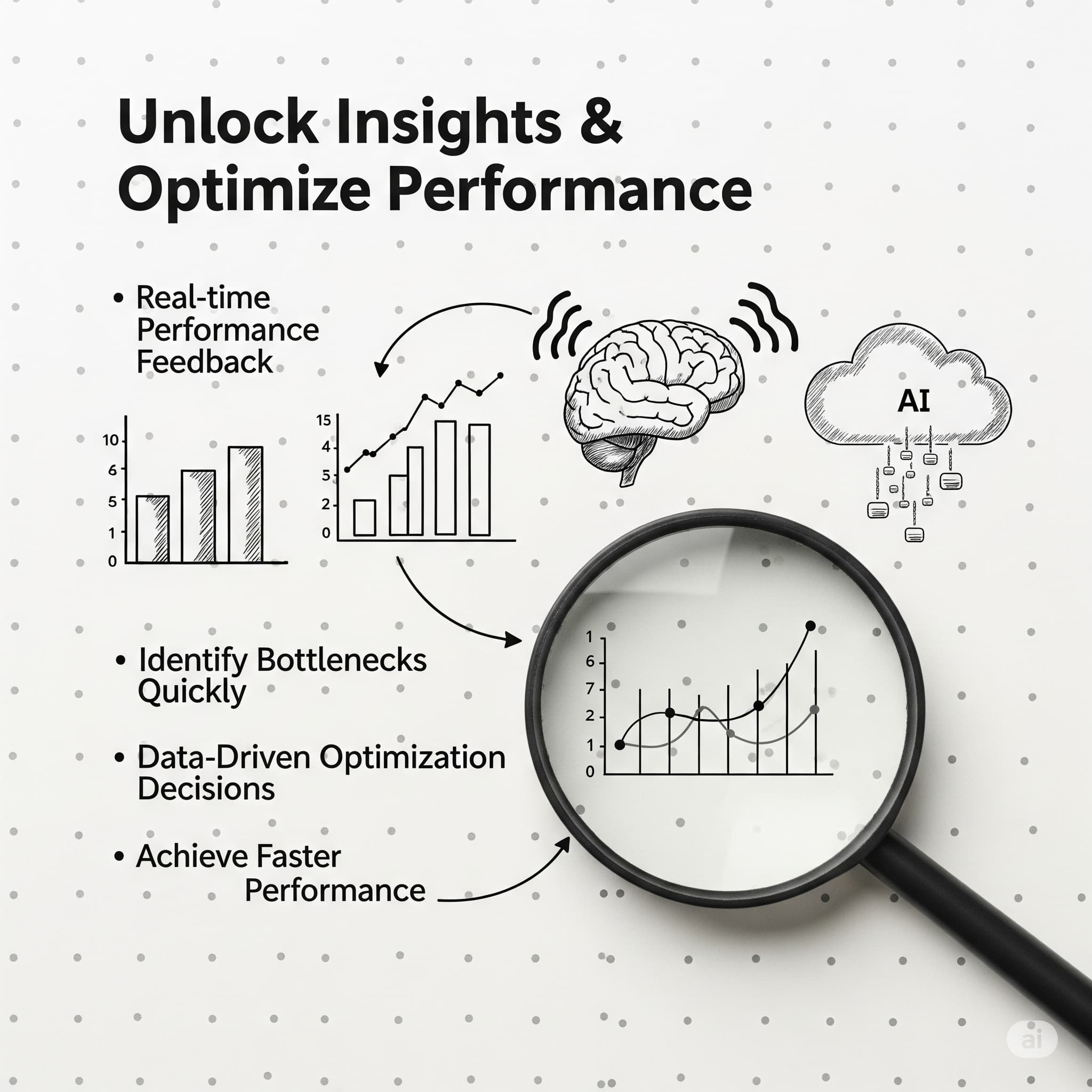 Caption: Visualizing how AI unlocks valuable insights for performance optimization.
- Advanced Anomaly Detection & Contextual Root Cause Analysis:
Moving beyond static thresholds, AI systems dynamically learn the “normal” operational baseline for thousands of metrics. They detect real-time deviations, even for previously unseen patterns. Crucially, AI excels at correlating anomalies across:
- Logs 📜
- Metrics 📊
- Traces 👣
- Events
- Change data By synthesizing this vast context, AI can rapidly pinpoint the most probable root cause of an incident, cutting down MTTR from hours to minutes—a task impossible for humans sifting through terabytes of data.
- Dynamic Capacity Planning & Resource Optimization:
AI analyzes historical resource utilization, traffic seasonality, and application growth trends to predict future capacity needs with high accuracy. This enables operations teams to:
- Proactively provision resources (e.g., spin up new cloud instances). ☁️
- Optimize cloud spending by identifying underutilized resources. 💰
- Ensure sufficient capacity for peak loads without costly over-provisioning. Reinforcement learning can even dynamically adjust real-time resource allocation based on observed performance and cost.
3. Enhanced Observability & Intelligent Insights: Clarity from Chaos AI can transcend raw observability data (logs, metrics, traces) by transforming it into genuinely actionable insights, providing unparalleled understanding of system behavior, user experience, and business impact.
- Intelligent Log Analysis & Pattern Recognition:
Manually sifting petabytes of unstructured log data (often petabytes in large enterprises) is a Sisyphean task. AI-powered log analysis tools (leveraging NLP, clustering algorithms, and anomaly detection) automatically:
- Identifies critical events. 🔍
- Groups similar entries.
- Detects novel patterns.
- Surfaces important information, drastically reducing noise. It can even extract structured meaning from unstructured text, turning raw logs into valuable data points.
-
Smart Alerting & Sophisticated Noise Reduction: The bane of operations teams is alert fatigue. AI algorithms can analyze historical alert patterns, correlate alerts from different sources (e.g., a CPU alert and a database connection error occurring simultaneously), and learn to identify true incidents while suppressing false positives or low-priority, benign notifications. This drastically reduces the volume of alerts, allowing operations teams to focus their attention on the most critical, high-impact issues, leading to faster, more effective responses. 🎯
- Personalized Dashboards & Contextual Recommendations:
AI can personalize observability dashboards based on the roles, responsibilities, and specific concerns of individual team members, highlighting the most relevant information. Furthermore, based on the analyzed data, AI provides actionable, contextual recommendations:
- Suggested optimizations.
- Diagnostic steps.
- Direct remediation actions. Essentially, AI acts as an intelligent co-pilot for SREs and operations engineers. 👨✈️
4. AI-Powered Governance, Security, and Compliance: Fortifying the Gates AI’s analytical prowess extends to the vital, often overlooked, but critical aspects of governance, security, and regulatory compliance within the DevOps lifecycle.
- Automated Compliance Checks & Policy Enforcement:
AI can be trained on regulatory requirements (e.g., GDPR, HIPAA, PCI DSS) and internal security policies. It can then automatically analyze infrastructure configurations, code changes, and deployment artifacts against these predefined compliance policies. This identifies:
- Potential violations. 🛡️
- Misconfigurations.
- Non-compliant practices before deployment. Result: Continuous adherence to regulations, significantly reducing audit risk and legal ramifications. ✅
-
Advanced Threat Detection & Proactive Vulnerability Management: AI-powered security tools leverage ML to analyze vast streams of network traffic, user behavior, code repositories, and system logs to detect sophisticated security threats and zero-day vulnerabilities that might bypass traditional signature-based detection systems. Machine learning algorithms can learn to identify subtle patterns of malicious activity, anomalous user behavior, or unusual code commits that indicate a potential breach or exploit. This provides early warnings, enabling security teams to proactively investigate and mitigate risks, shifting to a proactive defense. 🚨
- Intelligent Access Control & Anomaly-Based Security:
AI can assist in managing and enforcing complex security policies and access controls by analyzing user access patterns and identifying deviations from normal behavior. For instance, if an account typically logs in from a specific region during business hours suddenly attempts access from a different continent at 3 AM, AI can:
- Flag it as an anomaly. 🔒
- Potentially indicate a compromised account or insider threat.
- Trigger automated MFA requests or temporary lockouts.
Building the AI-Powered DevOps Future: Essential Considerations & A Strategic Roadmap 🗺️
While the transformative potential of AI in DevOps is undeniably immense, successfully realizing this vision is not a trivial undertaking. It demands meticulous planning, a strategic approach, and careful consideration of several interconnected factors. Organizations embarking on this journey must navigate technical complexities, foster new skill sets, and cultivate a culture of trust and collaboration.
1. Data Quality, Volume, and Availability: The Lifeblood of AI: AI algorithms are only as good as the data they’re trained on. In the context of DevOps, this means ensuring that logs, metrics, traces, deployment records, incident reports, code changes, and even test results are collected consistently, are accurate, free from bias, and easily accessible to AI models. Inadequate, inconsistent, or biased data will inevitably lead to inaccurate predictions, unreliable recommendations, and suboptimal automated decisions, undermining the very benefits AI is meant to provide. Implementing robust data governance strategies, comprehensive data collection pipelines, rigorous data cleansing processes, and standardized data formats (e.g., OpenTelemetry) are foundational prerequisites for any successful AI/AIOps initiative. Organizations must invest in data engineering to build a reliable data fabric. 🗄️➡️🧠
2. Model Explainability, Transparency, and Trust (XAI): In critical operational scenarios, where AI is making decisions that directly impact system stability, security, or business continuity, it is paramount for human operators to understand why an AI model is making a particular decision or recommendation. Explainable AI (XAI) techniques are vital here. They aim to provide insights into the reasoning, confidence levels, and input features that drive AI outputs, making the “black box” more transparent. This fosters trust among engineers, enabling them to validate, audit, and, crucially, override AI-driven actions when necessary. Without explainability, engineers may be hesitant to fully trust and adopt AI-driven automation, especially for high-stakes operational tasks, leading to underutilization or outright rejection. Building trust requires transparency, validation, and the ability to intervene. 🧐✅
3. Seamless Integration & Interoperability with Existing Toolchains: The modern DevOps landscape is diverse. Any new AI-powered solution must integrate seamlessly with existing:
- CI/CD pipelines.
- Monitoring systems.
- Incident management platforms.
- Code repositories.
- Cloud environments. Open APIs and standardized data formats are essential for avoiding vendor lock-in and creating a cohesive, functional AI-augmented DevOps ecosystem. Retrofitting AI into silos negates many benefits. A modular, API-first approach is key. 🔗🤝
4. Skill Development, Reskilling, & Cross-Functional Collaboration: Embracing AI in DevOps fundamentally necessitates a shift in required skill sets and a deepening of inter-team collaboration. This does not imply that every DevOps engineer must immediately become a machine learning expert or a data scientist. However, a foundational understanding of AI/ML concepts, how AI-driven tools operate, how to interpret their outputs, and how to effectively manage AI models in production (MLOps) is becoming increasingly important. Organizations must invest in reskilling existing talent through training programs, workshops, and mentorship. Furthermore, fostering robust collaboration between data science teams, who develop AI models, and DevOps engineers, who deploy and operate them, is crucial for building, deploying, and maintaining effective AI-powered solutions that align with operational realities and business objectives. 🎓🤝👩💻
5. Ethical Considerations, Algorithmic Bias, & Governance: As with any powerful AI, consider ethical implications and potential algorithmic bias.
- Biased Data: If an AI model (e.g., for resource optimization) is trained on historical data that reflects past biases, it could perpetuate or even amplify those biases.
- Fairness, Transparency, Accountability: Ensuring these in AI algorithms is essential to avoid unintended negative consequences. This requires robust data auditing, bias detection frameworks, human-in-the-loop validation, and clear governance policies for AI deployment. ⚖️🤖
6. A Phased, Iterative Approach & A Culture of Continuous Learning: AI adoption in DevOps is not an overnight “big bang.”
- Phased Approach: Start with specific, high-value, easier-to-implement use cases (e.g., intelligent log analysis for a critical application, predictive anomaly detection for core infrastructure, or AI-assisted code review for a specific codebase).
- Iterate & Learn: Learn from initial results, refine strategies, and gradually expand AI’s footprint. 🔄
- Continuous Learning: A culture of experimentation and adaptation is crucial, as both AI and DevOps practices evolve rapidly. This approach mitigates risk and realizes value throughout the journey. 🧪📈
Conclusion: Embracing the Intelligent Future of DevOps 🚀
The era of “guessing and grinding” in software development and operations is rapidly drawing to a close. Artificial Intelligence is a fundamental game-changer, offering the unprecedented potential to move beyond traditional automation and usher in truly intelligent, adaptive, self-optimizing software delivery systems.
By strategically leveraging AI for:
- Sophisticated intelligent automation. ✨
- Precise predictive analytics. 🔮
- Dramatically enhanced observability and insights. 📊
- Robust AI-powered governance and security. 🔒
Organizations can systematically dismantle the legacy of toil that has historically plagued DevOps teams. This transformation empowers developers and operations professionals to redirect their energies towards higher-value activities: fostering innovation, creative problem-solving, and delivering exceptional value to end-users with unparalleled speed and reliability. 💡
The journey towards an AI-powered DevOps future demands a meticulous strategic approach, an unwavering commitment to data quality and ethical AI practices, a continuous investment in skill development, and, most importantly, a collaborative mindset that spans the traditional boundaries between development, operations, and data science teams.
The immense rewards—increased efficiency, profound reliability, proactive incident prevention, a more secure software supply chain, and ultimately, a superior experience for both the engineers building the software and the users consuming it—make this strategic transformation not merely an option, but an imperative. By consciously and strategically embracing AI, we build a future where software development and operations are defined not just by speed and stability, but by intelligence, profound insight, and true developer empowerment. 🌟
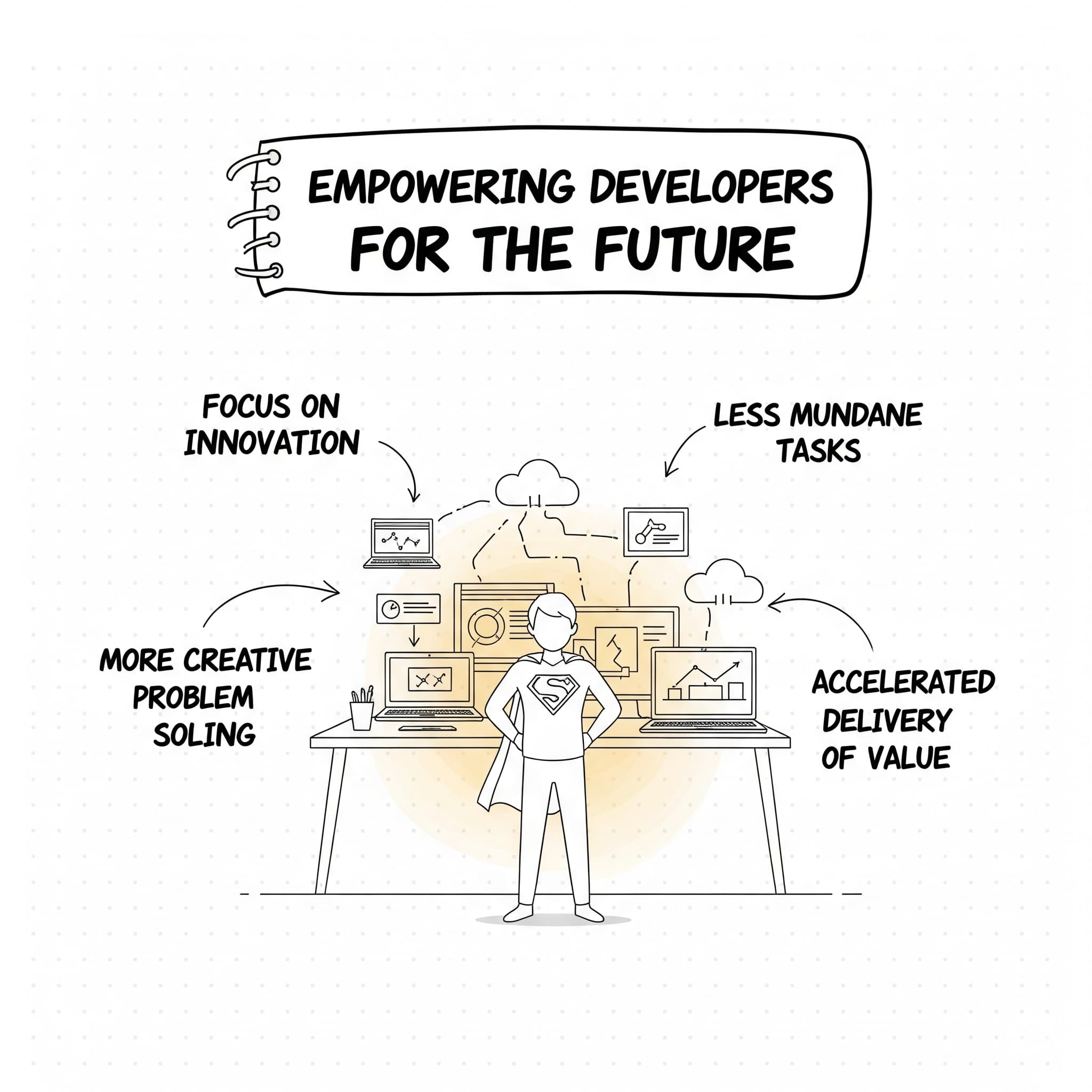 Caption: Envisioning a future where AI empowers developers for greater innovation.
Further Reading & Resources
- The Definitive Guide to AIOps - Broadcom (A comprehensive guide on AIOps)
- MLOps: A Comprehensive Guide on Best Practices - Satori Cyber (In-depth guide on MLOps best practices)
- Hype Cycle for Artificial Intelligence 2024 - Gartner (Gartner’s analysis of the maturity and adoption of AI technologies)
- OpenTelemetry Documentation (Official documentation for the OpenTelemetry framework)
Join the Conversation! 💬
What are your thoughts on AI’s impact on DevOps? Have you implemented any AI-powered solutions in your workflow? Share your experiences and insights in the comments below!